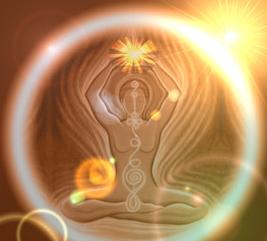
(1) Meditation Recollection: Samatha or Dyana: This concentration withdraws you from the external distraction until one day you get a first glimpse of your true Self. Samatha is the one-pointed concentration towards the 8th Jhana or absorption. Dyana is the early stages of the spiritual path where withdrawal from external objects is the main discipline.
(2) Simplification, Purification & Non-Attachment must be practised concurrently with dispassion and desirelessness and detachment during one’s daily routine. It is a total withdrawal in and outside of meditation. Resignations from all committees are mandatory. There should be no more acquisitions of properties and money. There should not be any attempt at climbing up any corporate or other institutional ladder. Life has to be overly simplified.
(3) Contemplation I – Vipassana (Stream-Enterer). Savikalpa Samadhi: To know your emotional & intellectual self with painful memories of the subconscious & unconscious. To know that every thing in the world is connected to you and each and every item is essential and beautiful (vegetation, animal & mineral). “Not a drop of water is ever lost in the universe”. This is the realisation of interconnectedness of the universe.
(4) Contemplation II – Vipassana (Once-Returner). Advanced stage of Savikalpa Samadhi: To come to know the true Self concretely and undoubtedly, and that this Satchit-ananda (soul or true Self) is never born and will never die. This same element of unity manifests in multiplicity as diverse “Things” in the world. You have come home to realize who you are. You are able to achieve Silence, Emptiness, Awareness & Stillness every day. This pure awareness is your true Self or soul (Atman), but you have not yet merged with God.
(5) Contemplation III – Vipassana (Non-Returner). Approaching Nirvikalpa Samadhi. The Dark Night of the Soul: You are in total darkness, silence and alone. Helpless, you must not strive anymore. You just surrender and wait for Grace to engulf you. When will it come is not known. It could be weeks, months or years. Then when it happens, utter bliss and joy will be your lot and then you begin to live in the world and yet out of this world. You are transmuted into One-with-the-Universe. The power of love manifest as light or heat and it is very healing.
(6) The Unitive Life of Enlightenment Arahant. Nirvikalpa Samadhi, few come down as in Sahaja Samadhi. Back to the world to service the world: “Everything you touch will turn to gold” – i.e. mended and healed within the karmic credit of the recipient. You are now a beacon to your community, country and the Universe! In this state of ultimate reality, there is no division as inner and outer. They are only differing aspects of the One without a second. The God-realized person sees the seamless garment of Being and, seeing it, quite naturally brings his or her activities more and more in alignment with that awareness. Amid the diversity of activities they may pursue, there is unity because he sees that all is Cosmic Consciousness and there is only Consciousness.
The practice of yoga is an art and science dedicated to creating union between body, mind and spirit. Its objective is to assist the practitioner in using the breath and body to foster an awareness of ourselves as individualized beings intimately connected to the unified whole of creation. In short it is about making balance and creating equanimity so as to live in peace, good health and harmony with the greater whole. This art of right living was perfected and practiced in India thousands of years ago and the foundations of yoga philosophy were written down in The Yoga Sutra of Patanjali, approximately 200 AD. This sacred text describes the inner workings of the mind and provides an eight-step blueprint for controlling its restlessness so as to enjoying lasting peace.
The core of Patanjali’s Yoga Sutra is an eight-limbed path that forms the structural framework for yoga practice. Upon practicing all eight limbs of the path it becomes self-evident that no one element is elevated over another in a hierarchical order. Each is part of a holistic focus which eventually brings completeness to the individual as they find their connectivity to the divine. Because we are all uniquely individual a person can emphasize one branch and then move on to another as they round out their understanding.
In brief the eight limbs, or steps to yoga, are as follows:
1. Yama : Universal morality
2. Niyama : Personal observances
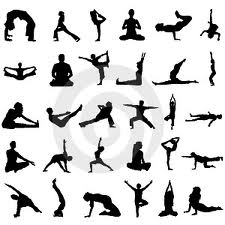
3. Asanas : Body postures
4. Pranayama : Breathing exercises, and control of prana
5. Pratyahara : Control of the senses
6. Dharana : Concentration and cultivating inner perceptual awareness
7. Dhyana : Devotion, Meditation on the Divine
8. Samadhi : Union with the Divine
The first two limbs that Patanjali describes are the fundamental ethical precepts called yamas, and the niyamas. These can also be looked at as universal morality and personal observances. Yamas and niyamas are the suggestions given on how we should deal with people around us and our attitude toward ourselves. The attitude we have toward things and people outside ourselves is yama, how we relate to ourselves inwardly is niyama. Both are mostly concerned with how we use our energy in relationship to others and to ourselves.
The yamas are broken down into five “wise characteristics.” Rather than a list of dos and don’ts, “they tell us that our fundamental nature is compassionate, generous, honest and peaceful.” They are as follows:
I. Yamas (Universal Morality)
1. Ahimsa – Compassion for all living things The word ahimsa literally mean not to injure or show cruelty to any creature or any person in any way whatsoever. Ahimsa is, however, more than just lack of violence as adapted in yoga. It means kindness, friendliness, and thoughtful consideration of other people and things. It also has to do with our duties and responsibilities too. Ahimsa implies that in every situation we should adopt a considerate attitude and do no harm.
2. Satya – Commitment to Truthfulness Satya means “to speak the truth,” yet it is not always desirable to speak the truth on all occasions, for it could harm someone unnecessarily. We have to consider what we say, how we say it, and in what way it could affect others. If speaking the truth has negative consequences for another, then it is better to say nothing. Satya should never come into conflict with our efforts to behave with ahimsa. This precept is based on the understanding that honest communication and action form the bedrock of any healthy relationship, community, or government, and that deliberate deception, exaggerations, and mistruths harm others.
3. Asteya – Non-stealing Steya means “to steal”; asteya is the opposite-to take nothing that does not belong to us. This also means that if we are in a situation where someone entrusts something to us or confides in us, we do not take advantage of him or her. Non-stealing includes not only taking what belongs to another without permission, but also using something for a different purpose to that intended, or beyond the time permitted by its owner. The practice of asteya implies not taking anything that has not been freely given. This includes fostering a consciousness of how we ask for others’ time for inconsiderate behavior demanding another’s attention when not freely given is, in effect, stealing.
4. Brahmacharya – Sense control Brahmacharya is used mostly in the sense of abstinence, particularly in relationship to sexual activity. Brahmacharya suggests that we should form relationships that foster our understanding of the highest truths. Brahmacharya does not necessarily imply celibacy. Rather, it means responsible behavior with respect to our goal of moving toward the truth. Practicing brahmacharya means that we use our sexual energy to regenerate our connection to our spiritual self. It also means that we don’t use this energy in any way that might harm others.
5. Aparigraha – Neutralizing the desire to acquire and hoard wealth Aparigraha means to take only what is necessary, and not to take advantage of a situation or act greedy. We should only take what we have earned; if we take more, we are exploiting someone else. The yogi feels that the collection or hoarding of things implies a lack of faith in God and in himself to provide for his future. Aparigraha also implies letting go of our attachments to things and an understanding that impermanence and change are the only constants.
The Yoga Sutra describes what happens when these five behaviors outlined above become part of a person’s daily life. Thus, the yamas are the moral virtues which, if attended to, purify human nature and contribute to health and happiness of society.
II. Niyama (Personal Observances)
Niyama means “rules” or “laws.” These are the rules prescribed for personal observance. Like the yamas, the five niyamas are not exercises or actions to be simply studied. They represent far more than an attitude. Compared with the yamas, the niyamas are more intimate and personal. They refer to the attitude we adopt toward ourselves as we create a code for living soulfully
1. Sauca – Purity The first niyama is sauca, meaning purity and cleanliness. Sauca has both an inner and an outer aspect. Outer cleanliness simply means keeping ourselves clean. Inner cleanliness has as much to do with the healthy, free functioning of our bodily organs as with the clarity of our mind. Practicing asanas or pranayama are essential means for attending to this inner sauca. Asanas tones the entire body and removes toxins while pranayama cleanses our lungs, oxygenates our blood and purifies our nerves. “But more important than the physical cleansing of the body is the cleansing of the mind of its disturbing emotions like hatred, passion, anger, lust, greed, delusion and pride.”
2. Santosa – Contentment Another niyama is santosa, modesty and the feeling of being content with what we have. To be at peace within and content with one’s lifestyle finding contentment even while experiencing life’s difficulties for life becomes a process of growth through all kinds of circumstances. We should accept that there is a purpose for everything – yoga calls it karma – and we cultivate contentment ‘to accept what happens’. It means being happy with what we have rather than being unhappy about what we don’t have.
3. Tapas – Disciplined use of our energy Tapas refers to the activity of keeping the body fit or to confront and handle the inner urges without outer show. Literally it means to heat the body and, by so doing, to cleanse it. Behind the notion of tapas lies the idea we can direct our energy to enthusiastically engage life and achieve our ultimate goal of creating union with the Divine. Tapas helps us burn up all the desires that stand in our way of this goal. Another form of tapas is paying attention to what we eat. Attention to body posture, attention to eating habits, attention to breathing patterns – these are all tapas.
4. Svadhyaya – Self study The fourth niyama is svadhyaya. Sva means “self’ adhyaya means “inquiry” or “examination”. Any activity that cultivates self-reflective consciousness can be considered svadhyaya. It means to intentionally find self-awareness in all our activities and efforts, even to the point of welcoming and accepting our limitations. It teaches us to be centered and non-reactive to the dualities, to burn out unwanted and self-destructive tendencies.
5. Isvarapranidhana – Celebration of the Spiritual Isvarapranidhana means “to lay all your actions at the feet of God.” It is the contemplation on God (Isvara) in order to become attuned to god and god’s will. It is the recognition that the spiritual suffuses everything and through our attention and care we can attune ourselves with our role as part of the Creator. The practice requires that we set aside some time each day to recognize that there is some omnipresent force larger than ourselves that is guiding and directing the course of our lives.
III. Asanas (Body postures)
Asana is the practice of physical postures. It is the most commonly known aspect of yoga for those unfamiliar with the other seven limbs of Patanjali’s Yoga Sutra. The practice of moving the body into postures has widespread benefits; of these the most underlying are improved health, strength, balance and flexibility. On a deeper level the practice of asana, which means “staying” or “abiding” in Sanskrit, is used as a tool to calm the mind and move into the inner essence of being. The challenge of poses offers the practitioner the opportunity to explore and control all aspects of their emotions, concentration, intent, faith, and unity between the physical and the ethereal body. Indeed, using asanas to challenge and open the physical body acts as a binding agent to bring one in harmony with all the unseen elements of their being, the forces that shape our lives through our responses to the physical world. Asana then becomes a way of exploring our mental attitudes and strengthening our will as we learn to release and move into the state of grace that comes from creating balance between our material world and spiritual experience.
As one practices asana it fosters a quieting of the mind, thus it becomes both a preparation for meditation and a meditation sufficient in and of itself. Releasing to the flow and inner strength that one develops brings about a profound grounding spirituality in the body. The physicality of the yoga postures becomes a vehicle to expand the consciousness that pervades our every aspect of our body. The key to fostering this expansion of awareness and consciousness begins with the control of breath, the fourth limb – Pranayama. Patanjali suggests that the asana and the pranayama practices will bring about the desired state of health; the control of breath and bodily posture will harmonize the flow of energy in the organism, thus creating a fertile field for the evolution of the spirit. “This down-to-earth, flesh-and-bones practice is simply one of the most direct and expedient ways to meet yourself. … This limb of yoga practice reattaches us to our body. In reattaching ourselves to our bodies we reattach ourselves to the responsibility of living a life guided by the undeniable wisdom of our body.”To this B.K.S. Iyengar adds: “The needs of the body are the needs of the divine spirit which lives through the body. The yogi does not look heaven-ward to find God for he know that He is within.”
IV. Pranayama (Breath Control)
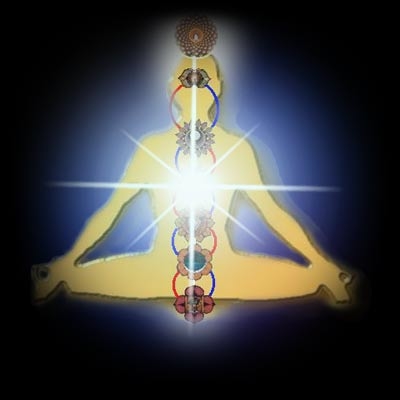
Pranayama is the measuring, control, and directing of the breath. Pranayama controls the energy (prana) within the organism, in order to restore and maintain health and to promote evolution. When the in-flowing breath is neutralized or joined with the out-flowing breath, then perfect relaxation and balance of body activities are realized. In yoga, we are concerned with balancing the flows of vital forces, then directing them inward to the chakra system and upward to the crown chakra.
Pranayama, or breathing technique, is very important in yoga. It goes hand in hand with the asana or pose. In the Yoga Sutra, the practices of pranayama and asana are considered to be the highest form of purification and self discipline for the mind and the body, respectively. The practices produce the actual physical sensation of heat, called tapas, or the inner fire of purification. It is taught that this heat is part of the process of purifying the nadis, or subtle nerve channels of the body. This allows a more healthful state to be experienced and allows the mind to become more calm.x As the yogi follows the proper rhythmic patterns of slow deep breathing “the patterns strengthen the respiratory system, soothe the nervous system and reduce craving. As desires and cravings diminish, the mind is set free and becomes a fit vehicle for concentration.”
V. Pratyahara (Control of the Senses)
Pratyahara means drawing back or retreat. The word ahara means “nourishment”; pratyahara translates as “to withdraw oneself from that which nourishes the senses.” In yoga, the term pratyahara implies withdrawal of the senses from attachment to external objects. It can then be seen as the practice of non-attachment to sensorial distractions as we constantly return to the path of self realization and achievement of internal peace. It means our senses stop living off the things that stimulate; the senses no longer depend on these stimulants and are not fed by them any more.
In pratyahara we sever this link between mind and senses, and the senses withdraw. When the senses are no longer tied to external sources, the result is restraint or pratyahara. Now that the vital forces are flowing back to the Source within, one can concentrate without being distracted by externals or the temptation to cognize externals.
Pratyahara occurs almost automatically when we meditate because we are so absorbed in the object of meditation. Precisely because the mind is so focused, the senses follow it; it is not happening the other way around.
No longer functioning in their usual manner, the senses become extraordinarily sharp. Under normal circumstances the senses become our masters rather than being our servants. The senses entice us to develop cravings for all sorts of things. In pratyahara the opposite occurs: when we have to eat we eat, but not because we have a craving for food. In pratyahara we try to put the senses in their proper place, but not cut them out of our actions entirely.
Much of our emotional imbalance are our own creation. A person who is influenced by outside events and sensations can never achieve the inner peace and tranquility. This is because he or she will waste much mental and physical energy in trying to suppress unwanted sensations and to heighten other sensations. This will eventually result in a physical or mental imbalance, and will, in most instances, result in illness.
Patanjali says that the above process is at the root of human unhappiness and uneasiness. When people seek out yoga, hoping to find that inner peace which is so evasive, they find that it was theirs all along. In a sense, yoga is nothing more than a process which enables us to stop and look at the processes of our own minds; only in this way can we understand the nature of happiness and unhappiness, and thus transcend them both.
VI. Dharana (Concentration and cultivating inner perceptual awareness)
Dharana means “immovable concentration of the mind”. The essential idea is to hold the concentration or focus of attention in one direction. “When the body has been tempered by asanas, when the mind has been refined by the fire of pranayama and when the senses have been brought under control by pratyahara, the sadhaka (seeker) reaches the sixth stage, dharana. Here he is concentrated wholly on a single point or on a task in which he is completely engrossed. The mind has to be stilled in order to achieve this state of complete absorption.”
In dharana we create the conditions for the mind to focus its attention in one direction instead of going out in many different directions. Deep contemplation and reflection can create the right conditions, and the focus on this one point that we have chosen becomes more intense. We encourage one particular activity of the mind and, the more intense it becomes, the more the other activities of the mind fall away.
The objective in dharana is to steady the mind by focusing its attention upon some stable entity.The particular object selected has nothing to do with the general purpose, which is to stop the mind from wandering -through memories, dreams, or reflective thought-by deliberately holding it single-mindedly upon some apparently static object. B.K.S. Iyengar states that the objective is to achieve the mental state where the mind, intellect, and ego are “all restrained and all these faculties are offered to the Lord for His use and in His service. Here there is no feeling of ‘I’ and ‘mine’.”
When the mind has become purified by yoga practices, it becomes able to focus efficiently on one subject or point of experience. Now we can unleash the great potential for inner healing.
VII. Dhyana (Devotion , Meditation on the Divine)
Dhyana means worship, or profound and abstract religious meditation. It is perfect contemplation. It involves concentration upon a point of focus with the intention of knowing the truth about it. The concept holds that when one focuses their mind in concentration on an object the mind is transformed into the shape of the object. Hence, when one focuses on the divine they become more reflective of it and they know their true nature. “His body, breath, senses, mind, reason and ego are all integrated in the object of his contemplation – the Universal Spirit.”
During dhyana, the consciousness is further unified by combining clear insights into distinctions between objects and between the subtle layers of perception. “We learn to differentiate between the mind of the perceiver, the means of perception, and the objects perceived, between words, their meanings, and ideas, and between all the levels of evolution of nature.”
As we fine-tune our concentration and become more aware of the nature of reality we perceive that the world is unreal. “The only reality is the universal self, or God, which is veiled by Maya (the illusory power). As the veils are lifted, the mind becomes clearer. Unhappiness and fear – even the fear of death – vanishes. This state of freedom, or Moksha, is the goal of Yoga. It can be reached by constant enquiry into the nature of things.”Meditation becomes our tool to see things clearly and perceive reality beyond the illusions that cloud our mind.
VIII. Samadhi (Union with the Divine)
The final step in the eight-fold path of Yoga is the attainment of Samadhi. Samadhi means “to bring together, to merge.” In the state of samadhi the body and senses are at rest, as if asleep, yet the faculty of mind and reason are alert, as if awake; one goes beyond consciousness. During samadhi, we realize what it is to be an identity without differences, and how a liberated soul can enjoy pure awareness of this pure identity. The conscious mind drops back into that unconscious oblivion from which it first emerged.
Thus, samadhi refers to union or true Yoga. There is an ending to the separation that is created by the “I” and “mine” of our illusory perceptions of reality. The mind does not distinguish between self and non-self, or between the object contemplated and the process of contemplation. The mind and the intellect have stopped and there is only the experience of consciousness, truth and unutterable joy.
The achievement of samadhi is a difficult task. For this reason the Yoga Sutra suggests the practice of asanas and pranayama as preparation for dharana, because these influence mental activities and create space in the crowded schedule of the mind. Once dharana has occurred, dhyana and samadhi can follow.
These eight steps of yoga indicate a logical pathway that leads to the attainment of physical, ethical, emotional, and psycho-spiritual health. Yoga does not seek to change the individual; rather, it allows the natural state of total health and integration in each of us to become a reality.
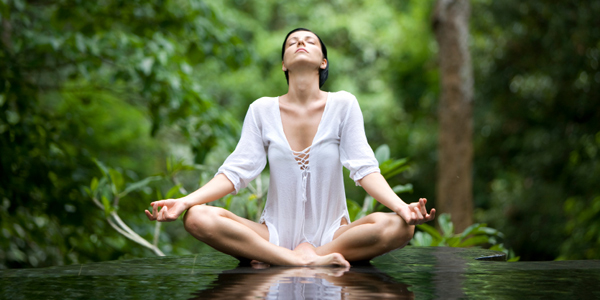
Samadhi is a spiritual experience that opens us to the highest state of consciousness and inner bliss. It is stepping into your enlightened nature that is free from all suffering. Samadhi is found through diving into a consistent state of pure consciousness, that is void of attachment to any thought. Samadhi is a deep personal, intimate merging with the divine inside you and all around you. It is being unified with the Universe through your consciousness.
When one reaches Samadhi there is a deep knowing that all is one, and that “oneness” is at the core of who you are. Samadhi gives you a moment to moment spiritual experience that is opening, trusting and softening into each new moment of your life. Samadhi is the eternally expanding realization that your ego is not real, and that you (the soul, spirit and divine essence) are what is truly real and will never die.
Laja Samadhi
It begins in deep meditation or Trance – even with movement such as dancing, etc.
It is state of joy, deep and general well-being, and peaceful meditation.
Savikalpa Samadhi
‘Savikalpa Samadhi’ refers to the initial (beginning) state of full valued Samadhi. In Savikalpa samadhi, for a short period of time you lose all human consciousness. In this state, the conception of time and space is altogether different.
With the human time you cannot judge; with the human way of looking at space you cannot judge. In that samadhi , for an hour or two hours you are completely in another world. You see there that almost everything is done.
Here in this world, there are many desires still unfulfilled in yourself and in others. Millions of desires are not fulfilled, and millions of things remain to be done. But when you are in Savikalpa Samadhi , you see that practically everything is done; you have nothing to do.
You are only an instrument. If you are used, well and good; otherwise, things are all done. But from Savikalpa Samadhi everybody has to return to ordinary consciousness.
Even in Savikalpa Samadhi there are grades. Just as there are brilliant students and poor students in the same class in school, so also in Savikalpa Samadhi, some aspirants reach the highest grade, while less aspiring seekers reach a lower or a middle rung of the ladder, where everything is not so clear and vivid as on the highest level.
In Savikalpa Samadhi, there are thoughts and ideas coming from various angles, but they do not affect you. While you are meditating, you remain unperturbed, and your inner being functions in a dynamic and confident manner.
Nirvikalpa Samadhi
‘Nirvikalpa Samadhi‘ is the highest samadhi that most spiritual Masters attain, and then only if they have achieved realisation.
When you have become one with the soul in Nirvikalpa Samadhi , there will be no ideas or thoughts at all. Here nature’s dance stops. There is no nature, only infinite Peace and Bliss. The Knower and the Known have become one. Everything is tranquil. Here you enjoy a supremely divine, all-pervading, self-amorous ecstasy. You become the object of enjoyment, you become the enjoyer and you become the enjoyment itself.
It lasts for a few hours or a few days, and then one has to come down. When one comes down, what happens? Very often one forgets his own name. One forgets his own age. He cannot speak properly. But through continued practice, gradually one becomes able to come down from nirvikalpa samadhi and immediately function in a normal way.
Generally, when one enters into Nirvikalpa Samadhi , one does not want to come back into the world again. If one stays there for eighteen or twenty-one days, there is every possibility that he will leave the body. But there is a divine dispensation.
Sahaja Samadhi
For Sahaja Samadhi, the Supreme’s infinite Grace is required. Sahaja Samadhi comes only when one has established inseparable oneness with the Supreme, or when one wants to show, on rare occasions, that he is the Supreme.
Sahaja Samadhi is by far the highest type of Samadhi . In this Samadhi, one is in the highest consciousness, but at the same time he is working in the gross physical world. One maintains the experience of Nirvikalpa Samadhi while simultaneously entering into earthly activities. One has become the soul and at the same time is utilising the body as a perfect instrument.
In Sahaja Samadhi, one walks like an ordinary human being. One eats. One does the usual things that an ordinary human being does. But in the inmost recesses of his heart, he is surcharged with divine illumination. When one has this Sahaja Samadhi, one becomes the Lord and Master of Reality. One can go at his sweet will to the Highest and then come down to the earth consciousness to manifest.
Mahasamadhi
Mahasamadhi is the final conscious abandoning of physical body. To achieve Mahasamadhi all karma needs to be completely dissolved – requiring that that individual has at least achieved self realization or soul realization (Samadhi) before being able to realize Mahasamadhi.
The physical body die. Soul/spirit doesn´t exist anymore then, that´s why it is called liberation/freedom… Then the spirit is including in everything & everywhere for ever – that´s is Oneness (or unity or infinity or universal consciousness or God) = that´s all is the same, only used different names for it. Every person that reached Samadhi /state without ego/ is beyond karma. Every this kind of living person is free & is going to “die” into mahasamadhi where become God at all, no more births as a human being. Become ONE with everything forever.
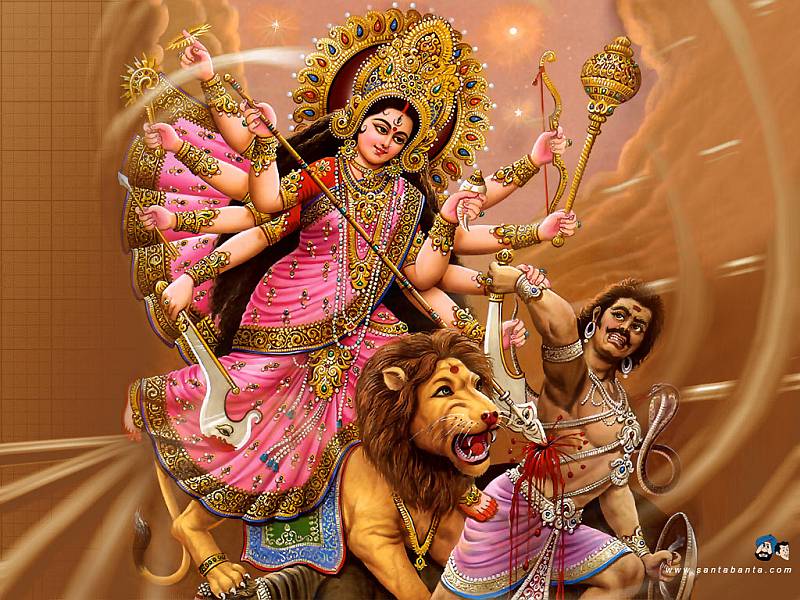
Durga (Sanskrit: दुर्गा); meaning “the inaccessible” or “the invincible”; “one who can redeem in situations of utmost distress” or “the one who eliminates sufferings ” is a form of Devi, the supremely radiant goddess, depicted as having eighteen arms, riding a lion or a tiger, carrying weapons and a lotus flower, maintaining a meditative smile, and practicing mudras, or symbolic hand gestures.
She is the Aadi Shakti (the original power).
An embodiment of creative feminine force (Shakti), Durga exists in a state of svātantrya (independence from the universe and anything/anybody else, i.e., self-sufficiency) and fierce compassion. Kali is considered to be an aspect of Durga. She is thus considered the fiercer, demon-fighting form of Shiva’s wife, goddess Parvati. Durga manifests fearlessness and patience, and never loses her sense of humor, even during spiritual battles of epic proportion.
Goddess Durga is the mother of the universe and believed to be the power behind the work of creation, preservation, and destruction of the world. Since time immemorial she has been worshipped as the supreme power of the Supreme Being and has been mentioned in many scriptures – Yajur Veda, Vajasaneyi Samhita and Taittareya Brahman.
The Many Forms of Durga
There are many forms of Durga: Kali, Bhagvati, Bhavani, Ambika, Lalita, Gauri, Kandalini, Java, Rajeswari, etc. Durga incarnated as the united power of all divine beings, who offered her the required physical attributes and weapons to kill the demon “Mahishasur”. Her nine appellationsare Skondamata, Kusumanda, Shailaputri, Kaalratri, Brahmacharini, Maha Gauri, Katyayani, Chandraghanta and Siddhidatri.
Durga’s Many Arms
Durga is depicted as having eight or ten hands. These represent eight quadrants or ten directions. This suggests that she protects the devotees from all directions.
Durga’s Three Eyes
Like Shiva, Mother Durga is also referred to as “Triyambake” meaning the three eyed Goddess. The left eye represents desire (the moon), the right eye represents action (the sun), and the central eye knowledge (fire).
Durga’s Vehicle – the Lion
The lion represents power, will and determination. Mother Durga riding the lion symbolises her mastery over all these qualities. This suggests to the devotee that one has to possess all these qualities to get over the demon of ego.
Durga’s Many Weapons
The conch shell in Durga’s hand symbolizes the ‘Pranava’ or the mystic word ‘Om’, which indicates her holding on to God in the form of sound.
The bow and arrows represent energy. By holding both the bow and arrows in one hand “Mother Durga” is indicating her control over both aspects of energy – potential and kinetic.
The thunderbolt signifies firmness. The devotee of Durga must be firm like thunderbolt in one’s convictions. Like the thunderbolt that can break anything against which it strikes, without being affected itself, the devotee needs to attack a challenge without losing his confidence.
The lotus in Durga’s hand is not in fully bloomed, It symbolizing certainty of success but not finality. The lotus in Sanskrit is called “pankaja” which means born of mud. Thus, lotus stands for the continuous evolution of the spiritual quality of devotees amidst the worldly mud of lust and greed.
The “Sudarshan-Chakra” or beautiful discus, which spins around the index finger of the Goddess, while not touching it, signifies that the entire world is subservient to the will of Durga and is at her command. She uses this unfailing weapon to destroy evil and produce an environment conducive to the growth of righteousness.
The sword that Durga holds in one of her hands symbolizes knowledge, which has the sharpness of a sword. Knowledge which is free from all doubts, is symbolized by the shine of the sword.
Durga’s trident or “trishul” is a symbol of three qualities – Satwa (inactivity), Rajas (activity) and Tamas (non-activity) – and she is remover of all the three types of miseries – physical, mental and spiritual.
Devi Durga stands on a lion in a fearless pose of “Abhay Mudra”, signifying assurance of freedom from fear. The universal mother seems to be saying to all her devotees: “Surrender all actions and duties onto me and I shall release thee from all fears”.

 towards the 8th Jhana or absorption. Dyana is the early stages of the spiritual path where withdrawal from external objects is the main discipline.




 Divine Soul Union